

LayerFS workspaces for every agent Magpie connects. Instead of each agent copying a project tree to work on it, agents share one durable, deduplicated history and work through stable filesystem paths: forking a branch for a parallel agent copies no file bytes, a checkpoint stores only what changed, and any agent can resolve, read and build on what the others committed.
What it adds
Eight tools, served on Magpie’s MCP server as layerfs_ plus the tool name:
provision— gives the agent a workspace for a project branch and answers the path to work in; the first provision imports the source directory the user chose, later ones answer the same path without copying the tree again.checkpoint— saves the workspace’s state on its branch, storing only the blobs the store has not seen, and reports added / modified / deleted counts plus the byte accounting.fork— forks a branch for a parallel agent: a pointer at an existing checkpoint, ready immediately, 0 bytes copied.publish— publishes a branch’s head as main’s new Layer, guarded so a publish can only move main forward;force: trueoverwrites deliberately and reports what it replaced.exec— runs a shell command in a branch’s workspace and checkpoints whatever it changed as one commit. Disabled by default; the user opts in.history— lists a branch’s checkpoints, newest first, with each one’s logical tree size and the bytes it actually stored.resolve— resolves a project, branch or file to a real filesystem path, its checkpoint and its content hash. An O(1) lookup, no copying.status— the backend in use, the projects and branches held, and the storage accounting.
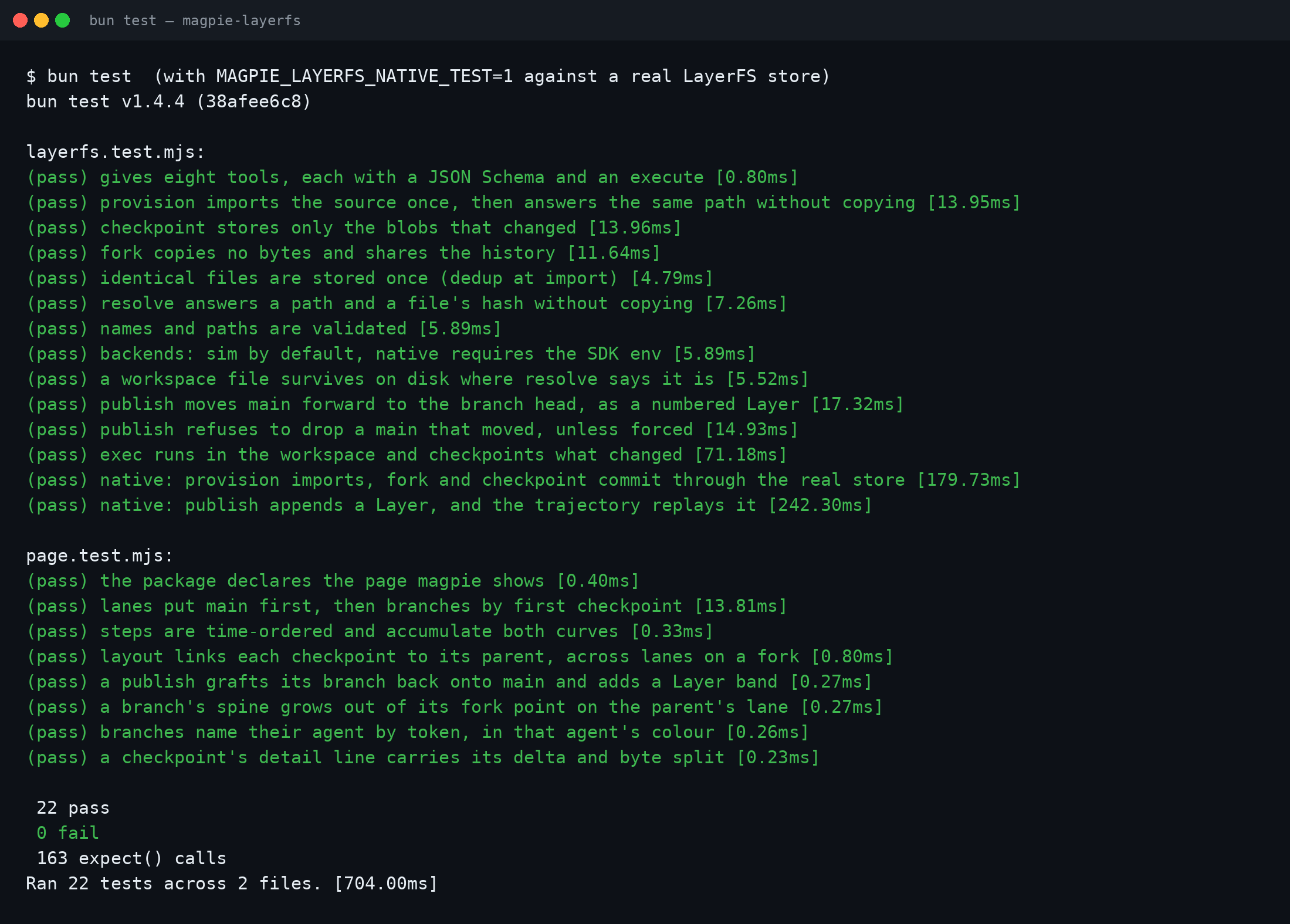
The package also declares a Magpie page, LayerFS trajectory, which replays how the agents’ worktrees grew: main as the green middle bough, each branch a bough of its own, a checkpoint a badge bearing its agent’s own icon, a fork a split and a publish a graft back onto main. Since 0.8.0 the page replays the real trajectory, refreshed on each commit, not the bundled sample.
How it works
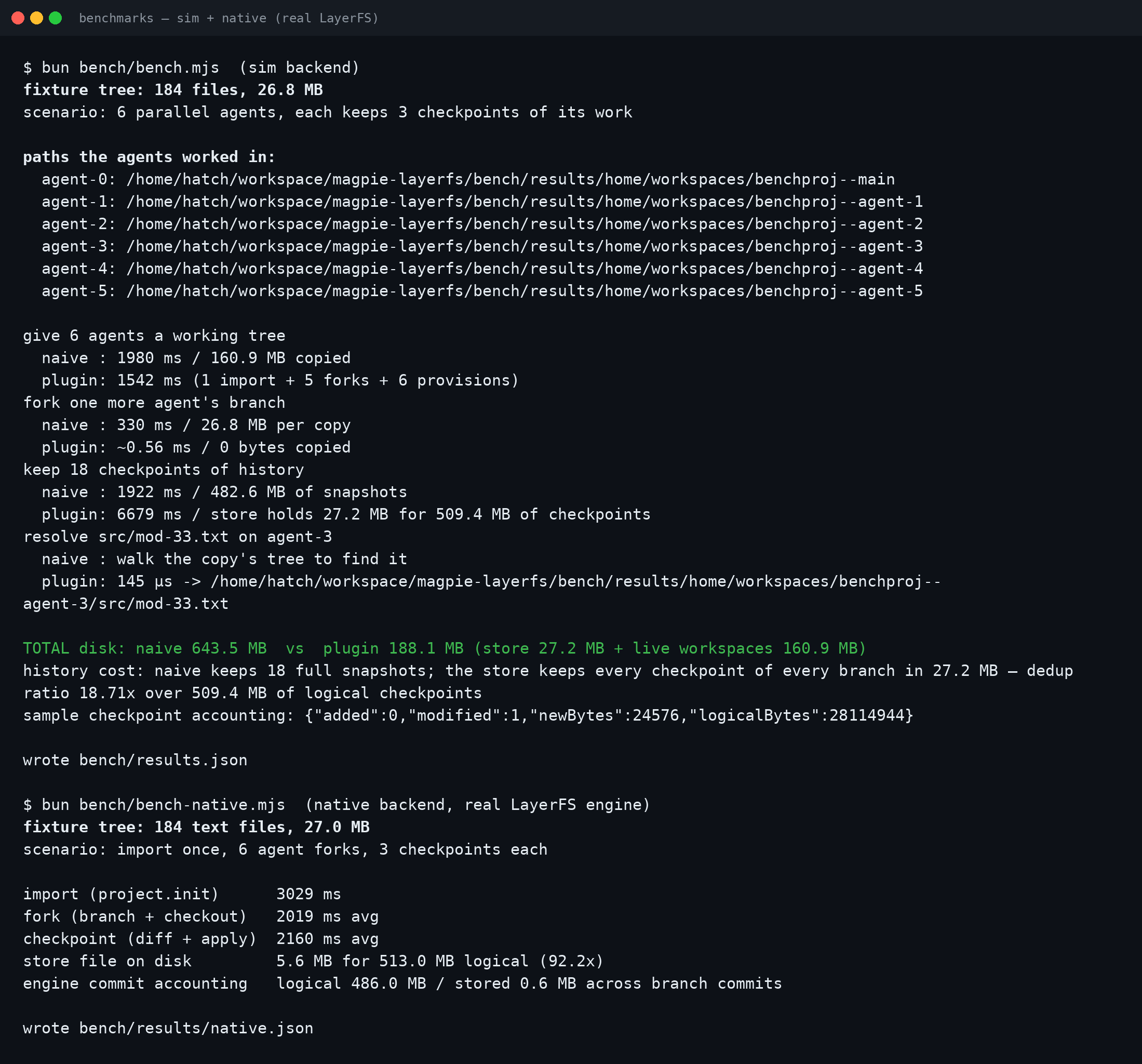
Two backends implement the same model. The native backend is the real LayerFS through its JavaScript SDK, @layerfs/agent: every SDK call happens in a child process shipped in the package, so the plugin host never imports the SDK, and a checkpoint lands as one fs.apply commit in the engine’s own store, with the engine’s chunk-level dedup. The sim backend is a local content-addressed store (immutable blobs named by SHA-256, branches as manifest pointers) that runs anywhere; it is the default, and it is what the Magpie community registry package ships.
On a 184-file, 26.8 MB project with 6 parallel agents keeping 3 checkpoints each (sim backend): forking one more agent takes about 1 ms and copies 0 bytes (a plain copy takes 321 ms and 26.8 MB), and 18 checkpoints holding 509.4 MB of logical trees occupy 27.2 MB of store — an 18.7× dedup.
You need
- Magpie, to host the plugin and serve its tools.
- For the native backend: Linux, a LayerFS checkout at the pinned commit with its native binding built (the install prompt covers the build; it needs a Rust toolchain), and Bun or Node to run the plugin’s test suite.
- Nothing extra for the sim backend.
Safety defaults are set for a host that serves tools to any caller holding a gateway key: provision requires an explicit source directory and refuses Magpie’s config directory, the credential stores and the plugin’s own store as sources; secret-shaped files never enter the store from an import; the store is private (0700 directories, 0600 records); exec and the native backend are both opt-in.
Limits
- Verified on Linux only. macOS and Windows are not tested by us.
- Binary files cannot round-trip through the LayerFS fs surface: writes accept bytes, but
fs.readrefuses binary content (upstream issue #417), so checkouts and checkpoints name the binary files they cannot move instead of dropping them. - The native backend is off by default and needs
LAYERFS_SDK_PATHset; the sim backend is what runs without it. - The same plugin is listed in the Magpie community registry (
@magpie-community/tools-layerfs, merged in PR #318) as a sim-only package at v0.7.1; the native backend ships from this repository. LayerFS.initrefuses a source tree on overlayfs, and its error there is opaque; import from a regular filesystem.